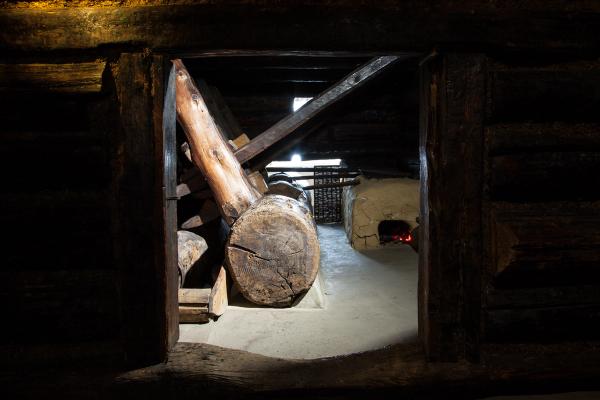
This is a folusz, or fulling machine, used in Poland since the 1500's to felt wool. It uses moving water to move the large piston so it beats the fabric in the trough below it, which contained hot water and possible other elements like urine, soap, or fuller's earth to help break down the fibers. The process took hours and was adjusting according to the desired quality of the wool. In the early modern era, Polish Jews used to wear a rough fabric called Jewish paklak, or wool fulled in machines like this one. The machine pictured here was reconstructed from a machine in the Polish Jaworki village and now sits on display at the Ethnographic Museum in Kraków. For video and a detailed outline of the fulling process, see this link.
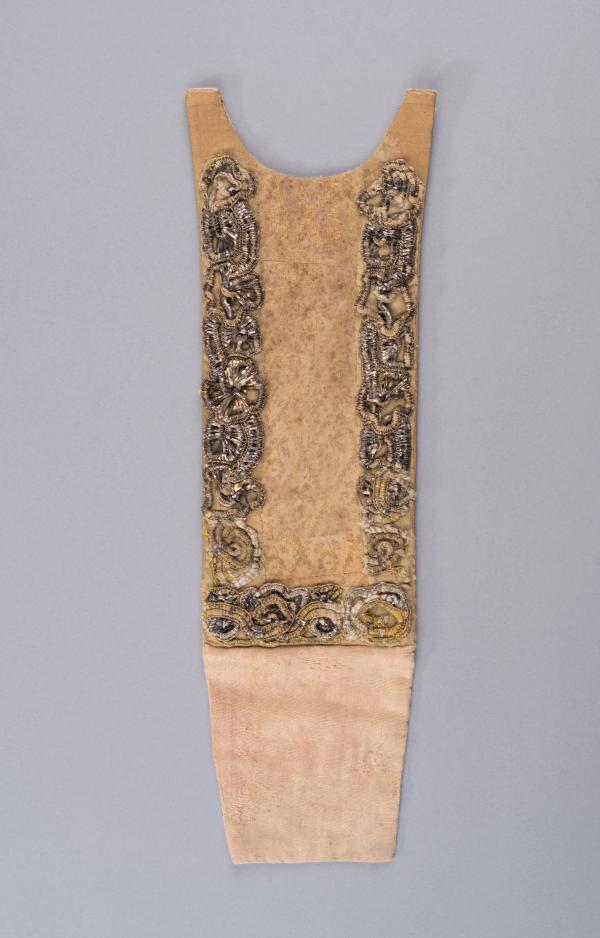
The brustukhe was worn ostensibly as a modesty piece, covering the front part of the bust, but was also frequently enjoyed as a decorative element. This one boasts shpanyer arbet, the Ashkenazi metallic lace surrounding the border, and the center cloth has white on white embroidery. This represents a typical layout known as di kastn (or box, referring to the border) und shpiegl (or mirror, referring to the symmetry). The brustukhe was fastened with strings, which seem to have worn off of this one, attached to the top flaps tied around the neck. The bottom flap was tucked into the skirt or apron to lock it in place.
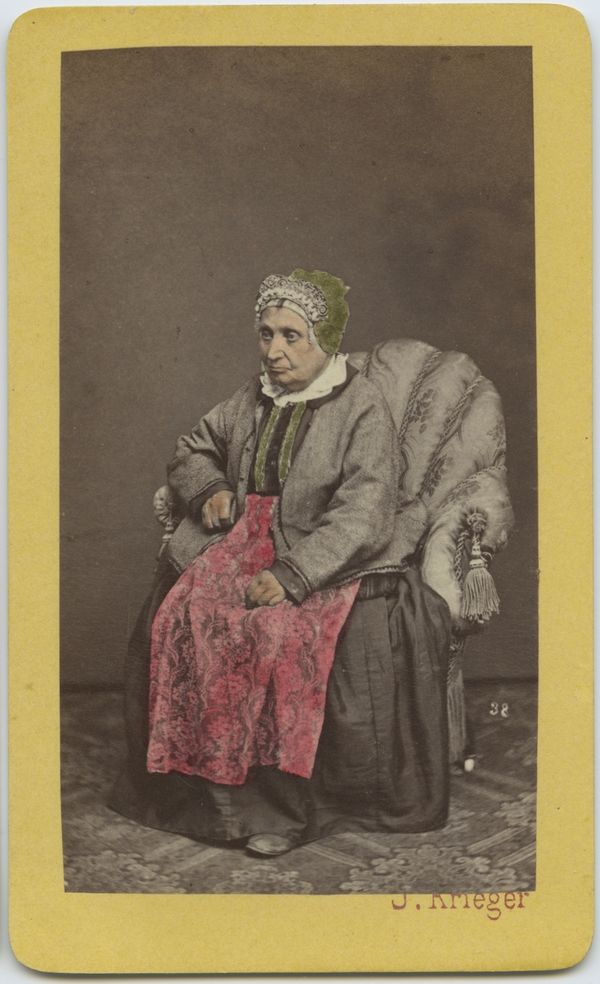
This is a photo from the workshop of Jewish 19th century photographer Ignacy Krieger. Krieger photographed many Krakovians, both Jews and non-Jews alike. This woman wears a typical outfit for a 19th century married, observant Jewish resident of Kraków on a nice day out: a brustukhe (the strip covering her shirt buttons, also pictured left), a lace collar, a cap covering her hair with a bit of lace peeking out along the hem, a diadem (the jeweled 'crown' above her forehead), and a printed, likely linen apron.